Blowing
Applied in tubes, ducts, trays, blocks, tunnels, collecting channels, with no risk of rodent attacks. Also applied for aerial installation between supports and buildings on external strength members or using the winding method.
Ducting
Applied in ducts, trays, blocks, tunnels, collecting channels, with a risk of rodent attacks.
Direct Buried
Applied in harsh environments with potential mechanical impact: in all ground types, swamps and harsh rivers.
Submarine
Applied in sea areas (coastal shelf and deep-sea), on navigable rivers, in lakes and water storage basins, in harsh environments, in bogs and unnavigable rivers.
Figure 8
Applied for aerial installations: on power lines, lamp posts, between buildings and constructions. Suitable for aerial installation on transmission equipment and power facilities in dielectric package.
Aerial
Applied for aerial installation on distribution and high voltage power lines, as well as railway catenary.
Indoor
Applied inside buildings (including vertical runs), in trays, channels, on outer sides of buildings, as well as in duct, in tubes and blocks. Suitable for blowing-in into protecting polyethylene tubes.
Drop
Applied for aerial installation on transmission towers, lamp posts, between buildings and constructions.
OPGW/Ground Wire
Applied in the construction of fiber-optic link on overhead transmission lines of 35 kV and more.
Fire Rated
Used for stationary installation when the optical fiber needs extra protection from mechanical damages.
Specialty Cable
For fiber optic monitoring systems.
Materials
2 February 2026
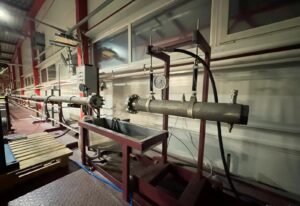
Incab has commissioned a new hydrostatic test bench at its testing center, significantly expanding the company’s capabilities for testing submarine cables. The equipment allows cables to be tested under conditions that accurately simulate extreme ocean depths.
Technical capabilities of the test bench include:
— Test track length: 100 meters. This allows a full cable section to be placed and tested under conditions similar to those on the seabed.
— Working pressure: up to 400 atmospheres. This recreates the pressure experienced at depths of up to 4 kilometers, where every square centimeter is subjected to the force of a 400-kilogram water column.
The test bench enables simulation of key real-world operating scenarios:
1. Leak and strength testing
The system verifies whether cable designs can withstand extreme hydrostatic pressure without structural damage.
2. Emergency scenario simulation
In the event of sheath damage, the test bench allows engineers to precisely determine how far water can propagate inside the cable.
The data obtained from these tests is critical for designing reliable submarine cable systems. It also enables more accurate planning of logistics and optimization of restoration costs in the event of potential incidents.
The commissioning of this new test facility further strengthens Incab’s testing capabilities and reinforces our commitment to delivering highly reliable solutions for building digital infrastructure — even in the most demanding underwater environments.